Instructions · Grit stages

Grit stages, explained

The rock tumbler grit stages each use a finer abrasive than the one before. Each grit removes the scratches left by the last, until nothing is left to remove but shine. Here is what each grit does, how long it runs, which one to buy, and when to move on.
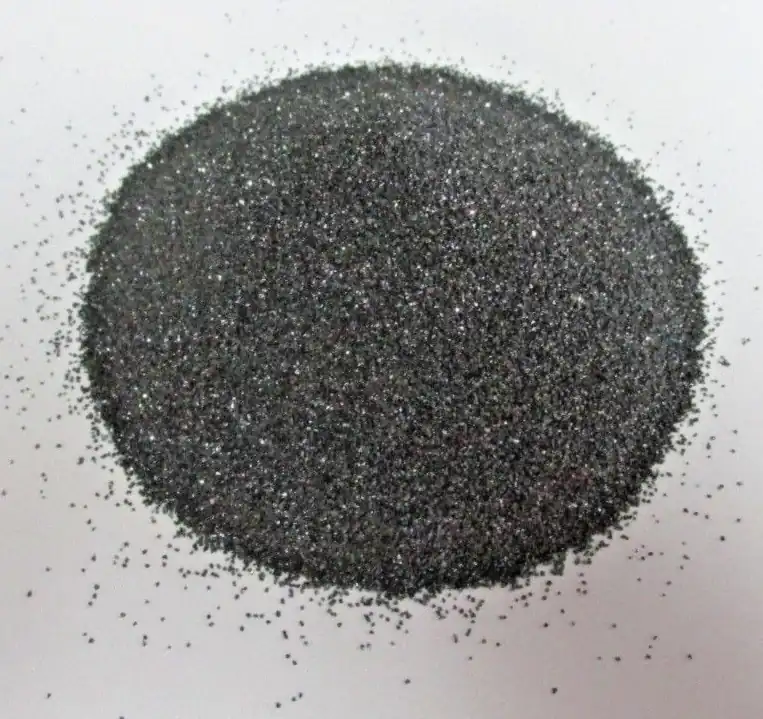
Pile of silicon carbide 60/90 grit
Coarse 36 to 60/90
Medium/fine 120/220
Pre-polish 500
Polish Aluminum oxide
The four stages

Rock tumbler grit stages at a glance

Most rocks go through the same four stages in a rotary tumbler. Only the first one changes depending on how rough your rock is.

1. Coarse · 36, 46/70, 60/90 or 80 silicon carbide · 7 days, often repeated

Grinds off rough edges and pits and sets the final shape.

Shop: 36 · 46/70 · 60/90 · 80

2. Medium/fine · 120/220 silicon carbide · 7 days

Removes the coarse scratches and leaves an even, smooth matte surface.

Shop: 120/220

3. Pre-polish · 500 silicon carbide · 7 days

Takes out the fine scratches so the polish has a clean surface to work on.

Shop: SiC 500

4. Polish · aluminum oxide or cerium oxide · 7 days

Smooths the surface until it reflects light.

Shop: Aluminum oxide · Cerium oxide

Don’t want to buy four bags? Our grit kits put the grit for a full run in one box, measured for a standard rotary barrel. Shop grit kits →

How grit works

Smaller numbers, bigger grains

Numbers mean mesh

Grit is sized by sieve. A 60/90 grit passes a 60 mesh screen and is caught by a 90, so lower numbers mean coarser grains. A graded range like 60/90 mixes sizes on purpose, so big grains do the heavy cutting while small ones fill the gaps. A single grade like 80 is one narrow size for a more even cut.

Silicon carbide cuts

Silicon carbide is harder than almost any stone you will tumble. Its grains break into fresh sharp edges as they wear, so they keep cutting all week. That is why it is used for the coarse, medium/fine and pre-polish stages.

Aluminum and cerium oxide polish

The final step uses a micron-sized powder. It doesn’t cut so much as smooth the surface until it reflects light. Aluminum oxide is the everyday polish; cerium oxide is the premium choice for maximum gloss, and for glass.
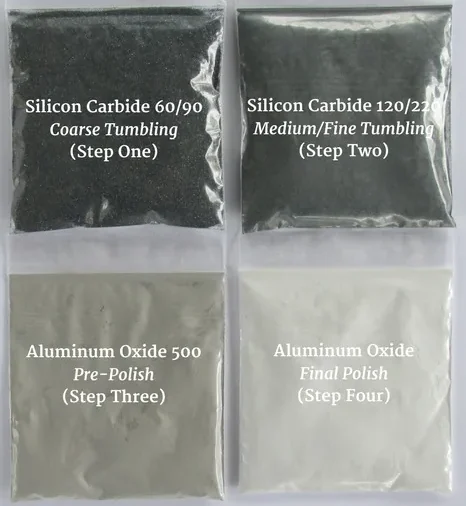
Four-step grit kit: silicon carbide 60/90 and 120/220, aluminum oxide 500 pre-polish and final polish
Choosing a coarse grit

Where to start

Start with the coarsest grit your rock needs. Not sure what you have? Check our Mohs hardness chart. Every step after that is the same for most stones.


36 extra coarse: very rough, angular rock or large pieces that need heavy shaping.

46/70 coarse: fast shaping for hard rough rock, with a slightly finer finish than 36.

60/90 coarse: the standard first step for agate, jasper and quartz.

Already smooth stones, like beach pebbles without pits, can often start at 120/220.
Stage by stage

What each grit stage does

What happens in the barrel at each stage, how to tell it is done, and the grit to use.

Stage 1: Coarse grind (36 to 60/90)

The coarse stage does most of the work. It grinds off sharp edges, cuts out pits and cracks, and sets the final shape of every stone. Everything after this step only refines the surface, so shape you don’t get here, you won’t get later.

Pick your coarse grit by how rough the rock is: 36 for very rough, angular pieces, 46/70 for fast shaping, 60/90 for most agate, jasper and quartz, and 80 single grade for an even cut on rock that is already fairly rounded. Not sure how hard your rock is? Check the Mohs hardness chart. Hard stones like agate and jasper may need two or three weeks in coarse. Softer stones like obsidian and turquoise need a gentler routine; see how to tumble softer stones.

If a stone still has rough spots after a week, run coarse again with fresh grit. Used grit has broken down and cuts far more slowly.

Shop coarse: Grit kits · 36 extra coarse · 46/70 (3 lb bag) · 60/90 (3 lb bag) · 80 single grade

Stage 2: Medium/fine (120/220)

Medium/fine removes the deep scratches left by the coarse grit and leaves every stone smooth, with an even matte surface when dry. It won’t change the shape, so only move on to it once the coarse stage is truly done.

This is also where the starting point can change: smooth beach pebbles or slabs that are already shaped can start here and save a week or more.

Shop medium/fine: Grit kits · 120/220 medium grit

Stage 3: Pre-polish (500)

Pre-polish is the step people are most tempted to skip, and skipping it is one of the most common reasons a polish comes out dull. Silicon carbide 500 takes out the fine scratches from 120/220 so the polish only has to bring up the shine. After a good pre-polish, stones have a soft satin sheen.

By now your stones are smaller and rounder than when you started. Topping up the barrel with ceramic filler keeps it at the right level and cushions the stones so they don’t chip.

Shop pre-polish: Grit kits · Silicon carbide 500 pre-polish · Ceramic filler mix

Stage 4: Polish (aluminum oxide or cerium oxide)

The polish stage brings up the glassy shine. Most tumblers use aluminum oxide, which gives a bright finish on agate, jasper and quartz. For stones that deserve maximum gloss and smoothness, cerium oxide is a very high quality polish, and it is wonderfully effective on glass.

The polish step is gentle, so stones can bruise if they knock together too hard. Adding plastic spacer pellets slows the tumble and protects soft or fragile stones. For an extra-bright finish after polish, try burnishing.

Shop polish: Grit kits · Aluminum oxide super fine polish · Aluminum oxide 500 · Cerium oxide polish · Plastic spacer pellets

Run times

How long each stage runs

Typical times in a rotary tumbler, using about 2 tablespoons of grit per pound of rock at every stage. Vibratory steps run 1 to 3 days. For exact amounts by barrel size, see our grit amounts chart.

1 · Coarse

7 days, repeat if needed

2 · Medium/fine

7 days

3 · Pre-polish

7 days

4 · Polish

7 days
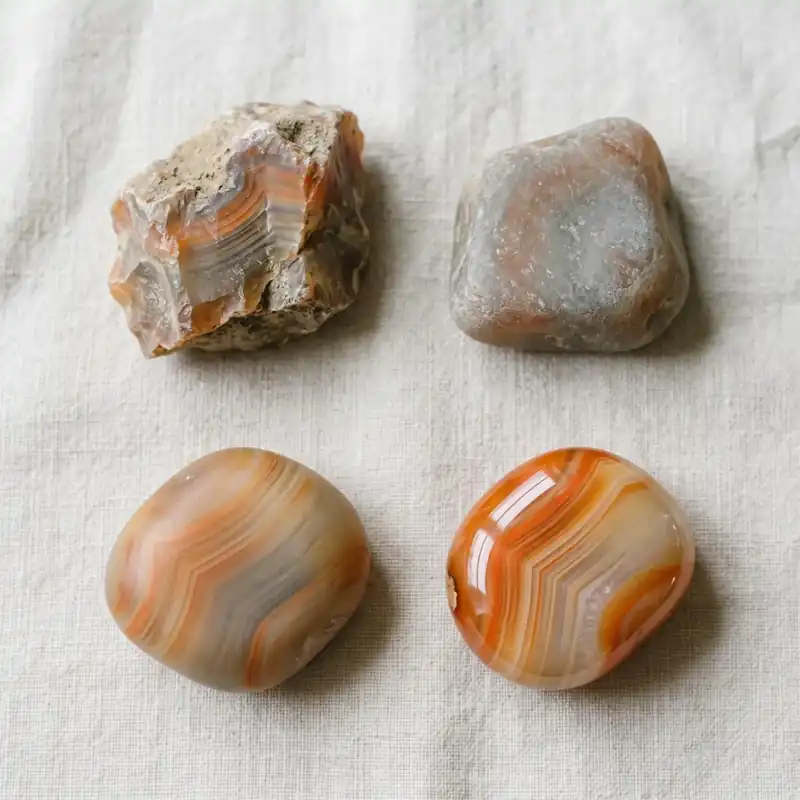
Rock tumbler grit stages shown on four agate stones: rough, matte after coarse grit, satin after pre-polish, and glossy after polish
Checking your stones

When to move on


After coarse, every stone should be the shape you want, with no pits or rough spots. Most later problems start here.

After medium/fine, stones should be smooth and evenly matte when dry.

After pre-polish, they should have a soft satin sheen.

After polish, dry a stone and check it in good light. Hazy spots usually mean leftover coarse grit. How to fix a hazy batch.

Don’t rush the coarse step

Finer grits can’t fix shape. If a stone still has rough spots, run coarse again with fresh grit.

Between stages

Keep your stages clean

One grain of coarse grit carried into the polish can scratch a whole batch. Do this between every stage.

  1. Pour the barrel through a colander over a bucket. Never pour slurry down the drain.
  2. Rinse the stones well and scrub any cracks with an old toothbrush.
  3. Scrub the barrel and lid until no grit is left in the seams.
  4. Set aside any stone that has cracked or chipped. It will shed grit into later steps.

Start every stage with fresh grit. Used grit has broken down and is mixed with rock mud, so it cuts slowly and can contaminate the next step. Here’s why you shouldn’t reuse grit, and how to get rid of slurry. For more on checking stones, read how to tell when a tumbling step is done. If a finish still comes out hazy, our troubleshooting guide lists the usual causes.

Two abrasives

Silicon carbide or aluminum oxide?

Silicon carbide

Sharp, very hard grains for the coarse, medium/fine and pre-polish steps. Cuts fast and keeps cutting as it breaks down.

Aluminum oxide

A fine white powder for the final step. Brings up a glassy shine on agate, jasper and quartz. For maximum gloss, or for glass, step up to cerium oxide.

Which grit to buy

Buy grit by kit, by tumbler, or by stage

There are three ways to stock up. Most people start with a kit, then buy single grits for the stage they run out of first, which is usually coarse.

Grit kits: the easiest way to tumble

Each kit puts the grit for a full run in one box, measured for a standard rotary barrel, so there’s nothing to weigh or guess.

Shop all grit kits →

Tumbler refills

Already own a brand-name tumbler? Our refills are matched to the barrel, so the amounts are right out of the bag.

Shop tumbler refills →

Single grits

Buy just the stage you need, or buy in bulk for big barrels. The coarse grits come in 3 lb bags for the stage you’ll repeat most.

Shop silicon carbide grit →   Shop polish →

FAQ

Grit stage questions

Quick answers to the questions we hear most about tumbling grit.

Can I skip a stage?

You can skip coarse if your stones are already smooth and well shaped, like pitless beach pebbles. Don’t skip pre-polish. Going straight from 120/220 to polish leaves fine scratches that the polish can’t remove, and the stones come out dull.

Can I mix different grits in one load?

No. Each stage only works if the grit is all one size range. A few coarse grains mixed into a finer step will keep scratching the stones. Finish one stage, clean everything, then move to the next. A grit kit keeps each stage in its own bag.

Can I reuse grit?

No. After about a week, silicon carbide has broken down into fine particles mixed with rock mud, and it cuts much more slowly. Start every stage, and every repeat of a stage, with fresh grit. Read more on reusing grit and slurry disposal.

What’s the difference between 60/90 and 46/70?

Both are coarse grits. 46/70 has bigger grains, so it removes rock faster and suits rough, angular pieces. 60/90 is a little finer and is the standard first step for most agate, jasper and quartz.

Do I need the pre-polish step?

Yes, for a good shine. Silicon carbide 500 removes the fine scratches from 120/220 so the polish only has to bring up the gloss. Skipping it is one of the most common reasons for a hazy finish.

Are the stages different in a vibratory tumbler?

The order is the same, but each stage runs 1 to 3 days instead of a week and uses much less grit. Vibratory tumblers don’t shape rock well, so start with stones that are already the shape you want. See our vibratory tumbler guide or the Vibratory Tumbler Grit Kit.

Aluminum oxide or cerium oxide for the polish?

Aluminum oxide is the everyday polish and works well on agate, jasper and quartz. Cerium oxide is a very high quality polish for stones that deserve maximum gloss and smoothness, and it is wonderfully effective on glass.

How many stages do soft stones need?

Soft stones like obsidian, turquoise and Apache tears go through the same four stages, but with shorter runs and more cushioning so they don’t bruise. Read how to tumble softer stones.

Not sure which grit you need?

Tell us what rock you have and what tumbler you run. We’ll tell you where to start and how much grit to use.

Shopping Cart
Scroll to Top